
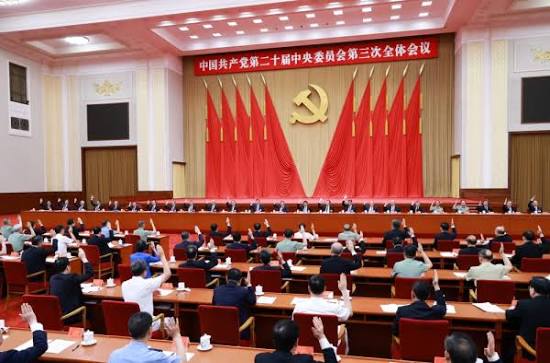
The fifth plenary session of the 20th Central Committee of the Communist Party of China, held in Beijing from Oct 26 to 29, focused on a pivotal issue for the country’s future: the Party’s capacity to govern itself while steering a highly complex modernization process.
The meeting examined measures to promote the implementation of full and rigorous Party self-governance at a time when China is embarking on the 15th Five-Year Plan (2026-30) period, a crucial phase aimed at basically achieving socialist modernization by 2035.
This is not just about strengthening internal discipline, combating corruption or ensuring compliance with directives.
It is about preserving the political, organizational and moral capacity of a force that is the decisive agent of China’s modernization. As development demands grow, so too must the Party’s ability to anticipate challenges, address shortcomings and maintain its connection with society.
The emphasis on full and rigorous Party self-governance highlights the challenges ahead.
China must sustain its economic and technological transformation, address structural imbalances and meet social expectations amid an increasingly uncertain and competitive international environment.
The CPC realizes that these challenges cannot be met through economic policies, administrative reforms or technological investment alone. They also require an organization capable of implementing decisions, coordinating different levels of government and maintaining strategic consistency.
Therefore, raising the standards of conduct and performance, addressing persistent problems and strengthening oversight mechanisms are necessary. Keeping the Party in good working order is a continuous requirement for effective governance.
This approach is an extension of the CPC’s long-standing concern about how to prevent a revolutionary organization, once transformed into a ruling party, from losing the vitality, discipline and social connectedness that fueled its rise.
Full and rigorous self-governance is aimed at identifying and tackling internal contradictions before they undermine its legitimacy and effectiveness. This approach carries broader and longer-term political significance by strengthening the capacity for self-correction, thereby helping to sustain trust and institutional legitimacy.
Governing for an extended period is not enough; the Party must develop the capabilities required to do so without allowing the prolonged exercise of power to weaken the very organization that wields it.
The trajectory of self-governance has expanded in scope. The eight-point decision of December 2012 established standards of conduct for leading cadres.
What began as an intervention targeting specific behaviors has evolved into a broader strategy of organizational transformation.
The difference lies not only in the intensity of the measures, but also in their implementation. The fight against corruption is increasingly integrated with oversight systems, disciplinary inspections, internal regulations and the supervision of power.
The goal is to simultaneously move in three directions: ensuring that officials are unable to engage in corruption, dare not do so, and have no desire to do so. This formula combines institutional prevention, sanctions and political education.
This evolution points to a significant innovation in governance that turns oversight into a systematic and permanent function. The CPC aims to prevent public policies from deviating from their objectives.
The challenge is to combine discipline, accountability and initiative, while avoiding a situation where the fear of making mistakes leads to inaction.
Strict self-governance aims to preserve the Party’s nature and founding mission. The concept rests on the premise that an organization aspiring to exercise power over the long term must develop mechanisms for detecting and correcting deviations.
Renewal cannot depend solely on external pressures or exceptional interventions; it must become an integral part of the Party’s regular functioning.
The legitimacy of this endeavor also depends on the Party’s relationship with society. It must demonstrate that its priorities translate into tangible improvements in people’s lives. One of the most demanding challenges of contemporary governance is ensuring that political commitments align with social reality.
This challenge is not unique to China; no political party in any country can indefinitely take its public connection for granted.
The fifth plenary session is significant in light of the stage of China’s modernization. As tasks grow more complex, the quality of Party cadres becomes increasingly important.
Grand strategies succeed only if those responsible for implementing them, from the central leadership to local levels, understand their objectives and can adapt them to specific circumstances.
Compliance with directives is necessary, but not sufficient. Professional competence, initiative, social awareness and willingness to assume responsibility also matter.
The question is how to instill a commitment to modernization throughout the Party’s structure, fostering conviction, creativity and a sense of public service.
For discipline to translate into governing capacity, it must be supported by training, evaluation, clear responsibilities and recognition of achievements. The fifth plenary session reflects the Chinese leadership’s belief that the success of modernization largely depends on the Party’s ability to renew itself and maintain cohesion, discipline and strategic direction.
Self-governance addresses the inherent risks of prolonged power and is essential for maintaining its leadership capacity during demanding phases. The implications are significant. Internal regulations, oversight, anti-corruption efforts and cadre evaluation form a Party-building experience worth examining beyond conventional categories used to understand political systems.
The ultimate test will be whether the Party can translate internal renewal into better policies, greater administrative effectiveness, improved self-correction and closer alignment with the aspirations of the people.
It will also depend on preserving cadre initiative while maintaining accountability and control over the exercise of power.
A Party in good working order is not merely a disciplined Party; it learns, corrects itself and mobilizes its members to respond to society’s needs.
Podes deixar aquí un comentario sobre o artigo